


What Makes a Property Attractive to Potential Buyers?
Rarely does a viewing crumble because of a single major mistake. A few little issues are usually the ones that begin to bother people. The photographs didn't do justice to the dim hallway. One drawer closes. The garden appears to be a task best tackled on a Saturday. While individually none of these problems would harm a house, they can add up to make the task seem more daunting. Why First Impressions Matter More Than Anything in Property Sales
People who have lived in a home for years learn its habits without thinking about them. The front lock needs a slight lift. One drawer sticks in damp weather. The scuff beside the stairs stopped being noticeable months ago.
A buyer meets all of that in one visit.
The opening few minutes can be difficult to undo. An older property may still feel reassuring when the entrance is tidy, the lights come on, and the first few things work as expected. A newer home can feel less convincing if a door jams, a handle shifts in the hand and a bulb is already out.
Most of the worthwhile jobs before a sale are the fiddly ones. They have been waiting for a spare afternoon because nothing is badly broken. In addition, there is the fact that until a new person enters through the door, a loose latch or chipped skirting board may not seem like a big deal.
How Kerb Appeal and Exterior Condition Influence Buyer Decisions
The front of the house gets judged while the buyer is still walking up from the car. The path, gate, planting, and windows have already been taken in before anyone says hello at the door.
A polished garden is not essential. A clear path helps. So does a gate that swings freely and planting that has not crept over the entrance. A few weeds between pavers will not sink a sale, but several unfinished exterior jobs can make the place look as though upkeep has slipped.
Water marks tend to pull the eye. Staining below a gutter or around a downpipe raises the obvious question of where rain has been going. Loose paving leaves a similar impression once somebody feels it move underfoot.
The nicest exterior work is often the work nobody mentions. Nothing catches a shoe. Not only that, but you must know that nothing will scrape the ground.
The Role of Natural Light and Open Spaces in Attracting Buyers
Firstly, one one, nobody can imitate daylight if you're looking for an authentic example; that much is certain. What's more, a small sitting room can feel pleasant when natural light reaches most of the space. A larger room can feel surprisingly dull if heavy curtains, dark furniture or thick planting outside takes away half the window.

There is often no building work involved in improving this. Curtains can open fully. A tall cabinet can move away from the glass. Shrubs can be cut back where they have slowly grown across a window. Houses are lived in rather than staged every day, so these changes tend to creep up unnoticed.
Furniture can make decent floor space awkward too. A sofa sitting across the natural route into a room forces people around it. A dining chair that has to be moved each time a door opens does much the same.
Even in luxury homes for sale in Houston, space alone is not enough. In fact, many buyers have and will still want rooms that feel natural to live in.
How Modern Kitchens and Bathrooms Add Instant Buyer Appeal
There is a case for your household rooms to notice. For you see, kitchens and bathrooms get extra attention because buyers know how quickly replacement costs can add up. A kitchen does not have to be new to feel acceptable.
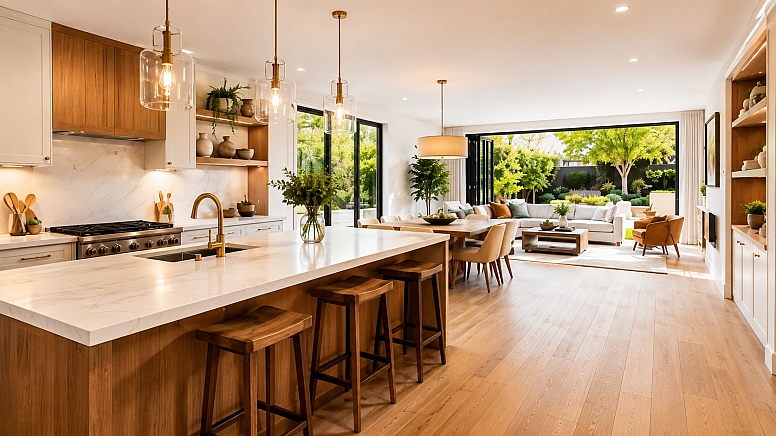
Cabinet doors that sit straight, a sound worktop and decent light over the prep area can carry an older room surprisingly well. A worn handle or tired line of sealant is a small job. Swollen cabinetry around the sink is not.
Lighting can catch people out too. A kitchen that looks fine at noon may feel flat by dinner time if one ceiling fitting is doing all the work.
Bathrooms are more exposed. There are fewer places for wear to hide. Cracked grout, dark silicone and a dripping tap may all be visible without anyone taking more than two steps into the room.
Moisture needs proper attention. Soft flooring, mould that keeps returning, or staining beneath a bathroom can point to a leak or poor ventilation. Covering the mark may improve the photograph for a while. The problem underneath is still there.
Why Energy Efficiency and Low Maintenance Features Are High on Buyer Lists
Energy performance is rarely the part of a viewing that gets anyone excited. It becomes more interesting later, when monthly costs start entering the conversation.
In a hot climate, buyers may notice which rooms become uncomfortable in the afternoon. Shading, suitable glazing and an air-conditioning system that has been looked after can all help. An older window is not automatically a bad window. Sometimes worn weatherstripping or a faulty lock is the real issue.
Low-maintenance features have a quieter appeal. Flooring that does not need immediate replacement, manageable planting, and exterior finishes in decent shape mean fewer jobs during the first months of ownership.
Receipts and service records are useful here. A recent HVAC service invoice gives a buyer something specific to look at. Calling a house “energy efficient” without any detail says very little.
How Location, Neighbourhood and Amenities Impact Property Attractiveness
Once the buyer has viewed the rooms and is visualizing a typical Tuesday, the location becomes more essential. Commutes, school runs, shopping outings and visits to relatives tend to count more than the verbiage used in a property description.

Households will prioritize various matters. One may value a peaceful street the most. If another person's commute is shorter, they could be willing to endure traffic. Schools, parks, restaurants, or airport access may all shift up or down the list depending on who is purchasing.
In many cases, specific, local details reveal more than general terms. Parking can be easy in the afternoon and awkward after dinner. A supermarket may be five minutes away on a Sunday, then twenty minutes in weekday traffic. A park can look close on a map but be unpleasant to reach on foot.
A seller cannot change the address. Straightforward information about the area is more useful than trying to make every nearby feature sound exceptional.
The homes that stay in a buyer’s mind are not always the newest ones. Often, they are simply the properties where very little gets in the way. The entrance feels looked after. The rooms are easy to use. A pricey remodeling is not immediately implied by the kitchen and bathroom.
The majority of the work is still performed by location, condition, and market need. A well-presented house simply has fewer superfluous features.
Categories
Recent Posts










0.0442