


Best Floor Area Ratio (FAR) Calculators for Architects, Developers & Homeowners
Floor Area Ratio (FAR) is a key metric in urban planning and architecture that determines how much floor space can be built on a site relative to its plot area. Understanding FAR is essential for architects, developers, and property owners to optimise building layouts, ensure zoning compliance, and make informed design decisions.
Using an online FAR calculator allows you to quickly estimate the maximum allowable building area, explore multi-storey options, and evaluate different development scenarios without manual calculations. Below is a curated list of the best FAR calculators available today.
Choosing the right FAR calculator can save time, ensure compliance, and help you visualise your site’s potential. Here are some of the top FAR calculators available online, with options suitable for both simple and complex projects.
Top FAR Calculators for Your Project
Find the right tool for your site. Try the SAO Architects FAR Calculator for professional multi-floor planning.
| Calculator | Multi-Floor Input | Max FAR Check | Best For |
|---|---|---|---|
| SAO Architects FAR Calculator | ✔ Yes | ✔ Yes | Professional architects, developers, and multi-storey projects |
| BeforeBricks FAR Calculator | ✖ No | ✖ No | Homeowners, students, casual checks |
Key Takeaways:
- SAO Architects FAR Calculator is the only tool with multi-floor input + max FAR check, making it ideal for professional project planning.
- BeforeBricks is best for quick, simple calculations for casual users or beginners.
For anyone looking to plan efficiently and stay compliant, the SAO Architects FAR Calculator remains the most professional and reliable choice. Beginners or casual users can still benefit from simpler tools like BeforeBricks for quick calculations.
SaoArchitects.com FAR Calculator
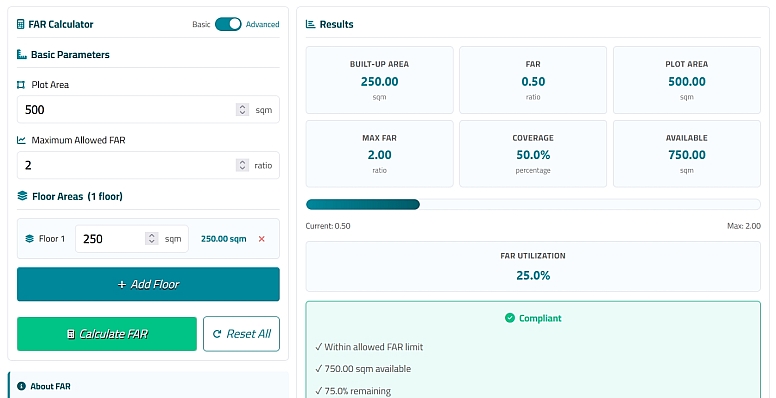
Why it stands out:
- Offers basic mode for quick calculations and advanced mode for more complex projects.
- Let's you input multi-floor areas for accurate FAR calculations.
- Includes a maximum FAR check to ensure compliance with zoning regulations.
- Calculates total built-up area and provides coverage/utilisation metrics.
- Ideal for developers, architects, and professional project planning.
Best for: Detailed multi-storey projects and compliance verification.
BeforeBricks FAR Calculator

Why it stands out:
- Quick and simple — just enter plot size and total building area.
- Minimalist interface, easy to use for casual checks.
Best for: Homeowners, students, or anyone looking for a fast, straightforward FAR number.
Frequently Asked Questions about Floor Area Ratio (FAR)
1. What does FAR stand for?
FAR stands for Floor Area Ratio. It measures the ratio of a building’s total floor area to the area of the plot it sits on.
2. How is FAR calculated?
FAR is calculated using the formula: FAR = Total Floor Area ÷ Plot Area. For multi-storey buildings, each floor’s area counts toward the total. For example, a 2,000 m² building on a 1,000 m² plot has a FAR of 2.0.
3. Why is FAR important?
FAR regulates building density, height, and bulk. It ensures developments comply with zoning laws, helps maintain environmental quality, provides adequate open space, and keeps developments aligned with available infrastructure and services.
4. What areas are included in FAR?
Typically, all enclosed, habitable floors are included. Some spaces, like basements, mechanical rooms, terraces, or roof gardens, may be excluded depending on local zoning regulations. Always check your municipality’s rules.
5. Can FAR values vary between cities or regions?
Yes. FAR limits differ between cities, neighbourhoods, and zoning districts. Local planning policies, urban density goals, and infrastructure capacity all influence the maximum FAR allowed.
6. What factors can influence FAR regulations?
FAR rules are shaped by urban planning priorities such as preserving open space, managing traffic, ensuring adequate infrastructure, protecting environmental or historical sites, and maintaining the character of the surrounding area.
7. Can FAR affect property value?
Yes. Higher FAR allows more buildable space, which can increase a property’s development potential and financial return. Conversely, a low FAR restricts building size and density.
8. How can a FAR calculator help?
A FAR calculator quickly estimates the allowed building area on a site, helps test design scenarios, ensures compliance with local zoning, and saves time compared to manual calculations.
9. Does complying with FAR guarantee project approval?
No. Meeting FAR requirements is only one part of zoning compliance. Authorities also consider height limits, setbacks, open space, design quality, and other local regulations when approving a project.
LEAVE A COMMENT
Categories
Recent Posts










0.0873