

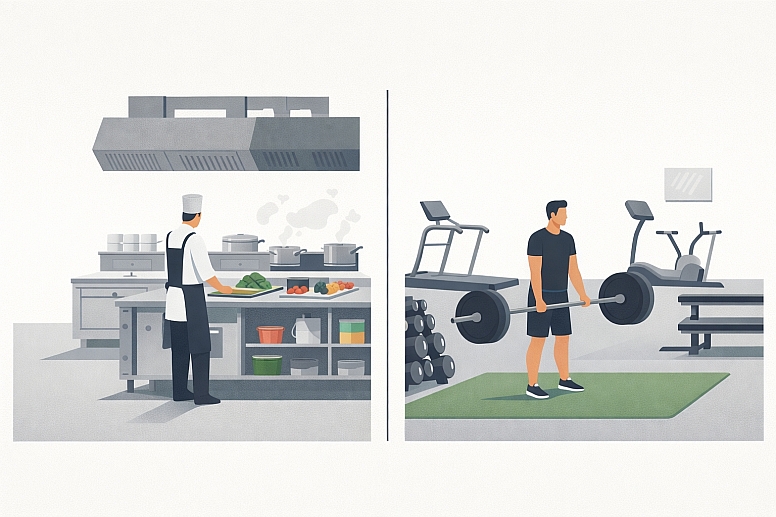
Designing High-Performance Industrial Spaces: Kitchens & Gyms
Designing industrial environments for food production and fitness is a discipline where performance, safety, and human behaviour intersect. Commercial kitchens and gyms are not simply utilitarian spaces filled with equipment; they are operational systems where design decisions directly influence efficiency, profitability, well-being, and regulatory compliance.
When executed correctly, a professional kitchen layout can increase operational productivity by as much as fifty per cent. Likewise, a strategically designed gym can significantly improve member retention in an increasingly competitive fitness market. In both cases, success depends on one central challenge: balancing strict operational requirements with the comfort, safety, and experience of the people who use the space every day.
Whether you are developing a restaurant, a delivery-only kitchen, or a fitness facility, getting the design fundamentals right from the outset is critical—particularly when working within regulated commercial environments such as those governed by local authorities in Widnes and across the wider North West.
Core Planning Principles for Industrial Environments
Function Comes First
Every effective design begins with purpose. In kitchens, the menu defines equipment selection, prep areas, storage needs, and service flow. In gyms, the training model—whether group-based, rehabilitative, or performance-focused—dictates spatial zoning and circulation. There is no universal layout; design must respond precisely to how the space will operate.
Workflow and Circulation
Clear, uninterrupted movement paths are essential. In kitchens, ingredients should move logically from delivery through storage, preparation, cooking, service, and cleaning without crossing paths unnecessarily. In gyms, members should be able to move intuitively between zones without congestion or confusion. Poor circulation leads to inefficiency, accidents, and user frustration.
Compliance Is a Starting Point, Not an Afterthought
Fire safety, ventilation, sanitation, accessibility, and structural requirements are non-negotiable. In areas such as Widnes, where commercial building and construction must meet both national regulations and local authority standards, early coordination with building control, environmental health, and fire services is essential to avoid costly redesigns.
Human-Centred Design
Industrial spaces are used intensively by people, often for long hours. Ergonomics, comfort, and psychological safety matter. A chef’s workstation should reduce physical strain; a gym layout should minimise intimidation and confusion. Design should actively support performance rather than simply accommodate equipment.
Flexibility for the Future
Menus evolve. Fitness trends change. Spaces that rely on fixed, inflexible layouts quickly become obsolete. Modular equipment, adaptable zones, and forward-thinking infrastructure allow businesses to evolve without major reconstruction.
Why Industrial Design Requires Specialist Expertise
Commercial kitchens and gyms are not scaled-up domestic spaces. They are engineered environments where design errors can result in injury, regulatory breaches, or business failure. A poor domestic kitchen layout might inconvenience a homeowner; a flawed commercial kitchen can cause fires, contamination, or forced closure.
In fitness environments, poor planning can lead to unsafe equipment use, member collisions, and heightened anxiety—particularly among beginners. Gym intimidation is a real and measurable barrier to participation, often intensified by overcrowding, unclear layouts, and poor visibility.
Industrial design addresses these risks through systems thinking. Every element—from flooring texture to ceiling height—must support safety, durability, and operational efficiency. For example:
- Commercial kitchen flooring must be non-slip, seamless, and coved at the walls to prevent bacterial buildup.
- Gym flooring must vary by zone: impact-absorbing surfaces for free weights, stable grip for functional training, and cushioned comfort for rehabilitation areas.
The goal is not aesthetic appeal alone, but the creation of a safe, efficient, and resilient operational system.
Zoning and Workflow as Design Foundations
Industrial spaces are best planned around workflows rather than rooms.
In kitchens, the classic operational sequence—delivery, storage, preparation, cooking, service, dish return, cleaning—should flow naturally with minimal backtracking. Good design reduces unnecessary steps, limits cross-traffic, and keeps hot, cold, clean, and dirty processes properly separated.
In gyms, zoning separates activities by intensity and purpose. High-energy areas such as weightlifting or HIIT should be visually and acoustically distinct from stretching, rehabilitation, or mobility zones. Flooring changes, lighting variations, and partial partitions can define zones without creating physical barriers.
This approach is particularly valuable in warehouse conversions and mixed-use developments common in industrial areas around Widnes, where existing building shells must be adapted thoughtfully rather than forced into unsuitable layouts.
The Hidden Systems Behind Successful Industrial Spaces
Life Safety and Regulatory Infrastructure
Fire suppression systems, compliant escape routes, and correct ventilation are foundational. Commercial kitchens require automated fire suppression beneath extraction hoods, while gyms must maintain clear egress paths and appropriate fire protection throughout.
Ventilation is equally critical. Kitchens must exhaust heat, grease, and smoke according to equipment output. Gyms require high air-change rates to maintain air quality, especially during peak occupancy.
Sanitation by Design
Hygiene must be engineered into the space. Kitchens rely on stainless steel surfaces, seamless wall finishes, and layouts that allow thorough cleaning. Gyms benefit from antimicrobial materials, accessible cleaning stations, and moisture-resistant locker room finishes to prevent mould and odour issues.
Structural and Electrical Capacity
Industrial equipment places heavy demands on buildings. Floors must support static and dynamic loads from ovens, refrigeration units, squat racks, and dropped weights. Electrical systems must handle high-amperage equipment without overload. These considerations are especially important when refurbishing older commercial buildings during construction projects in Widnes and similar towns.
Ergonomics and Human Movement
Design must account for how bodies move. In kitchens, this means correct worktop heights and safe equipment clearances. In gyms, machines must be spaced according to manufacturer guidelines, sightlines must remain open for supervision, and walkways must allow safe circulation even during busy periods.
Applying Design Principles to Real-World Scenarios

High-Volume Casual Dining Kitchens
Speed, consistency, and limited space define these environments. Zone-based layouts with central hot lines, under-counter refrigeration, and modular equipment improve efficiency and adaptability.
Boutique Fitness and CrossFit Studios
These facilities prioritise community and coached sessions. Durable flooring, wall-mounted storage, clear performance zones, and strong ventilation are essential—particularly in converted industrial units.
Large Commercial Health Clubs
Diverse users require clear zoning, intuitive wayfinding, and thoughtful separation of noisy and quiet activities. Lighting, spacing, and circulation play a major role in reducing anxiety and improving retention.
Ghost Kitchens
Efficiency is paramount. Linear workflows, dedicated packing areas, and separate driver access points support high-volume delivery operations without disrupting production.
Rehabilitation and Physical Therapy Gyms
Calm, supportive environments with semi-private zones, appropriate flooring, and controlled sensory input help clients feel safe and confident during recovery.
Modular Construction Versus Traditional Build-Outs
When planning industrial spaces, developers must choose between conventional construction and modular or prefabricated solutions.
Traditional build-outs offer full customisation but often involve longer timelines, higher disruption, and less cost certainty. Modular systems, increasingly popular in commercial kitchen construction, provide faster delivery, predictable costs, and easier future adaptation—advantages particularly relevant for fast-moving businesses in towns like Widnes, where speed to market can be a competitive advantage.
Advanced Considerations for Experienced Operators
- Circulation Psychology: Layouts should support natural movement patterns and reduce perceived exposure, especially for new gym users or high-pressure kitchen staff.
- Acoustic Control: Sound management improves comfort, reduces fatigue, and enhances safety in both kitchens and gyms.
- Lighting Strategy: Task-specific lighting improves performance, while thoughtful ambient lighting shapes mood and perception.
- Maintenance Planning: Easy access to services and durable, repairable materials reduces downtime and long-term costs.
Common Failures and Misconceptions
Training cannot compensate for poor design. If the layout encourages unsafe shortcuts, they will happen. Overcrowding equipment reduces capacity rather than increasing it. Designing only for current trends limits future adaptability. Open kitchens and open gyms are strategic choices—not automatic upgrades—and must be evaluated carefully.
A Practical Framework for Moving Forward
- Define the core purpose and user.
- Conduct an early regulatory review.
- Map primary workflows.
- Develop zone relationships before detailed drawings.
- Specify equipment and infrastructure accurately.
- Test layouts under peak-use scenarios.
- Commission, train, and refine before full operation.
Designing industrial kitchens and gyms is about far more than fitting equipment into a space. It is about creating environments that support performance, protect users, and enable long-term business success. Whether you are embarking on a new build, refurbishment, or modular installation—particularly within the commercial building and construction landscape of Widnes—thoughtful, specialist design is the foundation everything else depends.
The strongest projects begin not with drawings, but with clarity of purpose, regulatory understanding, and a commitment to designing for real-world use from day one.
LEAVE A COMMENT
Categories
Recent Posts









0.0653