

When Does CIS Apply to Building & Landscaping Work - When Doesn't It?
If you run a building or landscaping business in the UK, the Construction Industry Scheme (CIS) is something you need to understand, whether you're taking on subbies to help with an extension, hiring a specialist for roof repairs, or bringing in labour for a landscaping project.
Get it right, and it's a straightforward monthly admin task. Get it wrong, and you can find yourself on the wrong end of an HMRC penalty.
The challenge is that CIS doesn't apply to everything a building and landscaping company does. The line between what's in and what's out isn't always obvious, and it shifts depending on who the client is, who's doing the work, and how the contract is structured.
What is CIS & who does it apply to?
CIS is a tax scheme put in place by HMRC whereby contractors must make a deduction from payments they make to subcontractors for construction work. The deduction, either 20% for registered subcontractors or 30% for unregistered ones, is paid directly to HMRC and counts as an advance payment against the subcontractor's tax bill.
If you pay subcontractors to carry out construction work as part of your business, you are a contractor under CIS and must register. If you carry out construction work on behalf of a contractor, you are a subcontractor. Many businesses in the building trade are simultaneously taking on work from a developer above them while paying their own subbies below.
What building work falls under CIS?
The majority of mainstream building work is firmly within CIS. HMRC's definition of construction operations is broad and covers:
Extensions & new builds: Squarely within CIS. Any contractor paying subbies to lay foundations, build walls, or fit roofs on an extension or new build must make CIS deductions.
Alterations & repairs: This includes internal alterations, structural changes, and general repairs to buildings.
Brickwork & pointing: Within CIS, construction operations on the fabric of a building.
Roof repairs: Replacing tiles, repairing flashing, and structural roofing work fall within the scheme. Note that guttering and downpipes are specifically excluded from CIS as a repair or maintenance operation in their own right - though if guttering repair is bundled into the same contract as roofing work that is within CIS, the mixed contract rule can pull the whole contract into the scheme.
Installation of heating, lighting, & drainage systems: Explicitly listed in HMRC's definition of construction operations when carried out as part of a construction project.
What about landscaping, patios, driveways, and fencing?
This is where it gets more nuanced, and where building and landscaping businesses often get caught out.

Landscaping sits on a spectrum rather than falling cleanly inside or outside CIS. Groundwork and earthmoving that form part of a construction project - levelling a site for a development, preparing ground for a new build - is within CIS.
However, purely horticultural work such as lawn care, planting, routine garden maintenance, and decorative gardening is outside the scheme. The distinction is broadly between landscaping that involves construction-related operations and horticulture or maintenance that does not.
Patios and driveways involving hard landscaping - laying block paving, installing drainage, forming driveways as part of a wider construction project - are typically treated as construction operations and fall within the scheme where subcontractors are involved.
Fencing is similarly context-dependent. Erecting fencing on a construction site or as part of a development project is generally within CIS. Simple domestic boundary fencing not tied to construction operations may fall outside it. The nature and context of the work determine the position rather than the type of material used.
The residential exception — and why it matters
Here's the most important distinction for businesses like KH Building and Landscaping Services, which work for both residential and commercial clients.
Private householders are not contractors under CIS. If you are carrying out work directly for a homeowner - an extension to their house, a new patio in their garden, landscaping their back garden - the homeowner is the client, and CIS simply does not apply to that relationship. The homeowner has no obligation to deduct tax from what they pay you, regardless of how much they spend.
CIS only becomes relevant in that scenario if you then pay a subcontractor to carry out part of that work. At that point, you become the contractor, and you may need to make CIS deductions from what you pay your subbies - even though the end client is a private homeowner.
For commercial clients - property developers, businesses, landlords commissioning work on investment properties - the full CIS rules apply.
The mixed contract rule
One thing many building contractors don't know about is what happens when a single contract covers both CIS-covered work and work that would ordinarily be outside the scheme. HMRC's position is that where a contract includes construction operations alongside other non-exempt work, the entire payment falls within CIS.
A classic example in a roofing context: a contract to repair broken roof tiles (within CIS) and also clean the guttering (normally excluded) would bring the whole contract into the scheme.
It is worth noting that this rule applies to activities that are simply outside CIS - not to separately contracted professional services such as design or consultancy fees, which retain their exempt status regardless of whether they sit alongside construction work.
What genuinely sits outside CIS
A few activities are specifically excluded from CIS regardless of context:
Architectural & surveying services: professional consultancy work, design, and planning is not a construction operation and retains its exempt status even when carried out in connection with a construction project.
Delivering materials: transporting materials to the site without carrying out any installation is outside the scheme.
Scaffolding hire without erection: supplying the scaffold without the labour to put it up sits outside CIS.
Repairs to drainage systems, including guttering & downpipes: repair and maintenance of gutters, downpipes, and drainage pipes is specifically excluded, though installation of a new drainage system as part of construction is within the scheme.
What you need to do
If you pay subcontractors to carry out any of the construction work covered above, you need to be registered as a contractor with HMRC, verify each subcontractor before their first payment, deduct the correct amount from labour payments, issue payment and deduction statements, and file monthly CIS returns.
You can use the free CIS deduction calculator at ciscalculator.com to see exactly what the difference looks like between the 20% and 30% deduction rates on your payments.
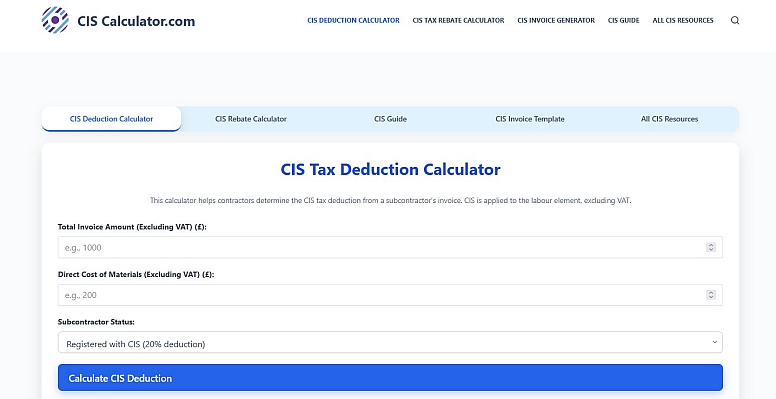
If you work as a subcontractor yourself - taking on work from a developer or main contractor - making sure you're registered for CIS will reduce the deduction from 30% to 20%, keeping more money in your account throughout the year.
About the author: This article was written with CIS Calculator, a free resource for UK contractors and subcontractors navigating the Construction Industry Scheme. CIS Calculator provides a free deduction calculator, tax rebate calculator, invoice generator, and a library of plain-English guides covering everything from registration to gross payment status. Visit ciscalculator.com for free tools and guidance.
LEAVE A COMMENT
Categories
Recent Posts










0.074